Saving Lives with Cheek Swabs: Stories from Brown Football’s Annual Bone Marrow Drive
3/18/2025
by: Linus Lawrence '25
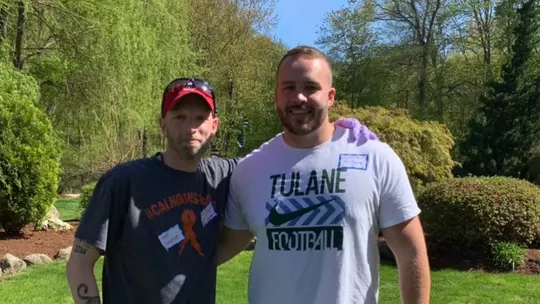
On Labor Day weekend in 2017, during a visit to his in-laws’ lakehouse in New Jersey, Jim Calhoun felt unusually tired. While washing his hands late one night, he passed out and hit his head against a granite countertop.
“I thought it was just because I was doing so much at that time,” he remembered.
Calhoun was soon diagnosed with acute lymphoblastic leukemia, which he was told had a 20% survival rate. After six weeks of chemotherapy, he needed a bone marrow transplant.
“The reason I fell down was because I only had 12 platelets in my body,” he explained. “An average person has anywhere from 250,000 to 500,000. So if I had fallen asleep or I didn’t hit my head, they probably would’ve found me dead.”
At the time, Christian Montano ’18 was a senior offensive lineman for the Brown football team. Just after arriving home for Thanksgiving Break, he got a call from the Rhode Island Blood Center informing him that he was a preliminary candidate for someone who needed a transplant. After undergoing further testing and discovering he was a match, Montano became a donor on February 1, 2018.
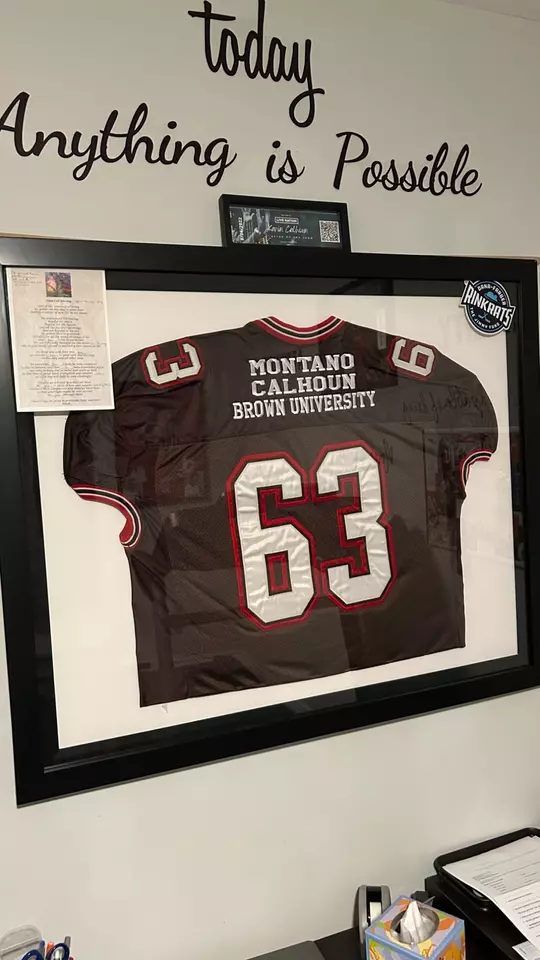
“It was a little surreal at first,” Montano said. “You sign up with the thought that you’ll never get the call, but when it does come, it was pretty cool.”
On February 1, 2019, he got another unexpected call. “Hi, this is Jim Calhoun,” the voice on the phone told him. “I was your bone marrow recipient.”
Montano had registered with the National Marrow Donor Program during his freshman season as part of the football team’s annual Bone Marrow Drive. Over the years, the drive — set to occur for the fourteenth time this Wednesday — has led to the registration of 2,604 individuals and yielded 36 donations. At least seven former Brown football players have donated since the event’s inception.
“Whether you play football or not, you can get involved,” said Paul Frisone, Coordinator of Football Operations & Player Development. “Lives have been saved because of this event.”
The partnership between NMDP and college athletics began in 2008, when the organization and Villanova football head coach Andy Talley formed the Get in the Game program to promote awareness and registration on campuses. Today, the program has over 325 schools participating, with Brown’s total donations ranking 5th in the nation.
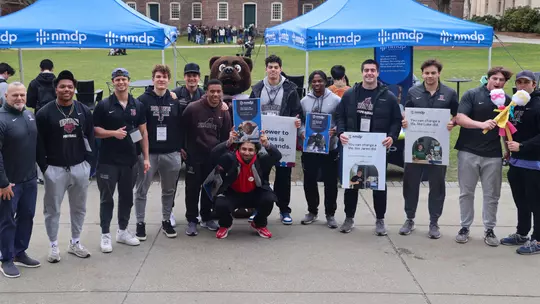
“It’s amazing work to partner with these student athletes and leave that legacy on their campus,” said Jamie Robenhymer, a Member Recruitment Coordinator with NMDP. “The impact is happening even years after that student leaves, which is really powerful.”
Every time a donor comes from a campus drive, NMDP emails the team’s coaches to congratulate them and urge them to communicate to players that a patient’s life was changed “because of that one day that you volunteer for a couple hours, have some fun and add potential donors to your registry,” Robenhymer said.
Collegiate teams are particularly good partners for NMDP since they help to attract eligible and diverse registrants. A person can only donate if they are between 18 and 60 years old and in good enough health to do so. Additionally, while white patients in need of a transplant are 79% likely to find a match, that number dips below 50% for Hispanics and Latinos or Asian and Pacific Islanders. For African-American patients, the odds are just 29%.
“There is no greater place to find young, healthy people from every background than on a college campus,” Frisone said.
Much like the football team’s Bench Press for Cancer fundraiser in the fall, the Bone Marrow Drive takes place outside Sayles Hall each spring. During the drive, players work to attract attention from those traversing the Main Green and get them to register via a simple cheek swab.
“Brown is a well-oiled machine,” Robenhymer remarked. “The football players on the team are very excited, and especially when this is their junior or senior year…they know what works. They know what doesn’t work. They know what to say. It gets a little bit easier every year, and they have fun with it.”
Once someone registers, they’re likely to never interact with NMDP again. But for some, whether in weeks, months, or years, they receive a call like Montano’s.
“I almost didn’t pick it up,” recalled running back Mark Kachmer ’13, who had graduated four years earlier and assumed he was the target of a telemarketer. “I never answer those calls, nor do I stay on the phone long enough to hear people talk.”
“You do it and you kind of think, ‘Oh, I’m sure nothing will ever happen,’” said offensive lineman Jared Shimberg ’18. “For me, nothing did happen for about a year. And then I got a call.”
But even if a registrant ends up being a perfect match for a patient, the decision of whether to donate remains theirs. For some, the choice may be difficult, and for others it couldn’t seem more simple.
“Why would I not do that? The minor inconveniences of having to go to a hospital and get your blood work done and go under the knife for just a little work? ” Kachmer said. “I don’t know, I got off work that day.”
“Maybe it’s just what my parents and people have ingrained in me as they’ve raised me: Do good if you’re able to, and there doesn’t need to really be a cost-benefit analysis of it,” Kachmer continued.
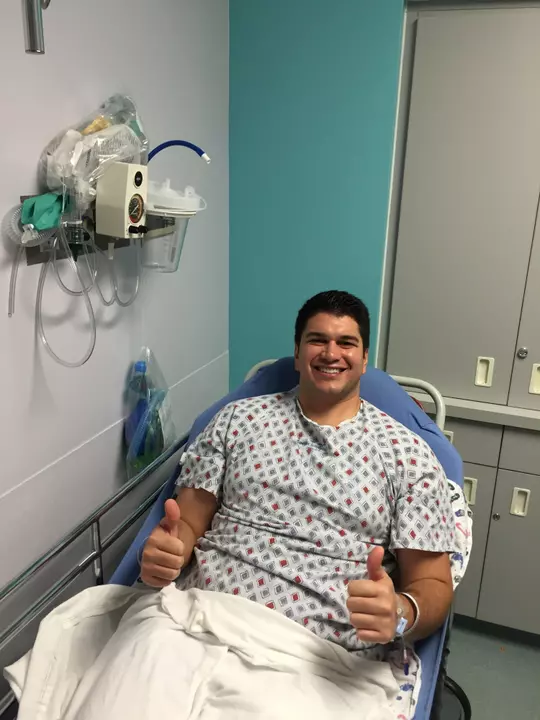
For Montano, the decision was influenced by family history. “Three of my four grandparents actually passed away from cancer, so to have the opportunity to help someone was a no-brainer,” he explained. “I was absolutely bought in from the second they told me I could help.”
Because he had an autoimmune disease, Montano would need to undergo surgery — a more invasive donation process in which bone marrow is withdrawn from the pelvic bone — as opposed to the less invasive stem cell donation process, which 90% of donors now undergo.
“It was kind of a big decision for me,” said offensive lineman Cole Hooper ’13.5, who was asked to donate bone marrow through surgery and found the prospect “a little scary” beforehand. “It was just a really eye-opening process, a really rewarding thing to be able to do,” Hooper reflected.
Another rewarding element of the donation process is the possibility of becoming acquainted with one’s recipient — or, in Montano’s case, practically becoming a member of their family.
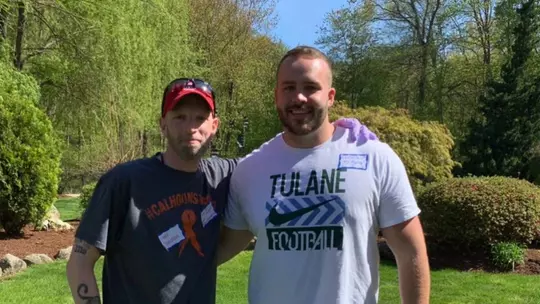
In May of 2019, the Montanos invited Calhoun to drive down from Saratoga Springs and spend the weekend at their home in Orange, Connecticut. “I was just so overwhelmed,” Calhoun recalled, “but as soon as I met Christian, I had a brother for life.”
“It was surreal to learn his backstory of what happened to him, his timeline of events,” Montano said. “It was really special to see just how two totally separate lives kind of intertwined at this incredible moment.”
The two still text about sports or to celebrate the anniversary of the donation. Now seven years post-transplant, Calhoun is in good health, though quick to joke that he’s “not as fit as Christian is,” nor can he throw a football as well despite the new DNA.
“I can’t thank him enough for what he has done,” Calhoun said. “Giving me a second chance at life and to spend more time with my wife and my kids and my friends and family…I’m forever grateful. I don’t know how I could ever repay him.”
“It always changes your perspective on life when you realize how fragile life can be, and how quickly everything can be taken away from you,” said Montano, now 29 years old. “Don’t take anything for granted, seize every opportunity you can, and really enjoy being with the people you’re around as much as you can.”
The NMDP initially maintains a restriction on contact between donors and recipients, only allowing them to speak with one another a year after the date of the donation if both parties agree. For many donors, their recipient remains a mystery.
“I still have no clue,” said Kachmer, who donated to the same recipient first via surgery and later via stem cell transplant. “I was given a very limited piece of information. They said there was a really young boy who I think lived somewhere in the Midwest, and that was all I’d ever know.”
“I wasn’t able to have any communication,” Hooper said. “I never knew if they lived or not, or if they even got to live one more day.”
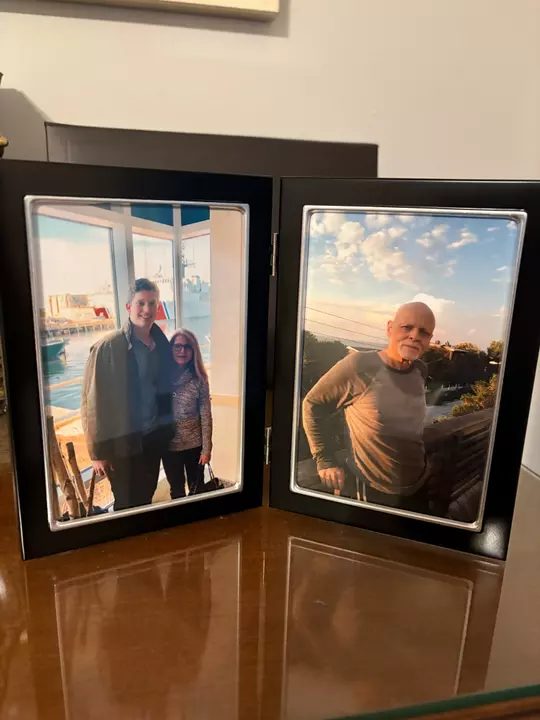
Shimberg, meanwhile, received a letter from his improving recipient’s wife, Ellis, expressing her and her husband Jeff’s excitement to meet him. “I was so happy to hear from her,” Shimberg said. “I was really hopeful to be able to meet them someday.”
Months later, he received a follow-up note from Ellis that Jeff had passed away. “It sort of broke my heart,” Shimberg said. Nonetheless, Shimberg and her met for lunch one day in Boston. “She told me all about her husband, and I told her all about myself. She was so thankful for what I did,” he recalled. “It was sort of bittersweet…it was a blessing just to be able to meet her.”
Some bonds between donor and recipient go even deeper.
On April 9, 2013, Kristine Palmero — a history teacher at The Wheeler School — was walking down Hope Street when she stepped on a flyer for the Brown football team’s annual drive. Palmero was grieving the loss of one of her advisees, Elizabeth Gao, and so she decided to wander across College Hill to register.
“It was a nice day,” Palmero remembered. “I figured if I go to Brown, at least kids will be happy around me and I can buy myself two more hours of being happy.”
Months later, Palmero received a letter informing her that she might be a match for a patient, and eventually she donated bone marrow through surgery. She had the procedure in April, and by May she was dancing at her sister’s wedding.
Palmero later flew out to California to meet her recipient: a twelve-year-old fellow Filipino named Mailyna. According to Palmero, as of 2022 just .03% of the national registry identifies as Filipino, and the Philippines doesn’t have a registry at all. One of Palmero’s doctors called her Mailyna’s “one-in-a-million match.”
“You’ll hear stories about Filipinos needing matches, but their possible match is in a country where they can’t get a visa to come to the U.S.,” Palmero said. “It’s really quite sad.”
Palmero recalled being surprised when Mailyna’s mother thanked her, not realizing the “depths of the mom’s relief or gratitude” until she became a parent herself.
“If you have ever loved anybody, and you knew what the possibility is of this person surviving because somebody helped them, you wouldn’t be ambivalent,” Palmero said about the decision potential donors are faced with. “Your back still hurts, but someone gets to add months or years or an entire lifetime to their timeline…if you get the call, you shouldn’t blink.”
While in California, Palmero spoke on the phone with Mailyna’s great-grandmother and discovered that, in addition to now sharing an immune system and blood type, Palmero and her recipient shared another connection. Generations earlier, Mailyna’s great-grandmother had known Palmero’s grandfather growing up in a small, rural town in Pangasinan in the Philippines — a revelation which Palmero called “magical.”
Palmero shared her improbable story in a Ted Talk three years ago, and continues to share it with her English classes at Milton Academy.
“Every year I teach seniors,” she said, “and I tell them, ‘Listen, this is what I hope you take away from having me as your teacher: when you turn eighteen, register.’”
Last week, Palmero came to Providence to remind the football team of the drive’s impact as they prepare for this year’s event.
With the swab of a cheek at Sayles Hall on Wednesday, everyone from intrigued passersby to the football players themselves — or even someone who accidentally steps on a flyer on Hope Street — has the chance to take the first step towards saving a life.
“I just can’t emphasize enough: probably one of the easiest things I ever had to do was just to give a cheek swab,” Hooper said.
“You’re never thinking that this could happen,” Shimberg said, “but then when you go through it and you’re like, ‘oh, I might have a chance to do a small part in saving someone’s life,’ that hits you really hard and it’s really special.”