.png&width=60&height=60&type=webp)

Changing Course and Changing Tires: Jakob Prall’s Journey from Brown Football to NASCAR Pit Crew
10/4/2024 1:00:00 PM | Football
By: Linus Lawrence '25
They say every Brown graduate forges a unique path after walking out through the Van Wickle Gates. For few students can this statement be truer than in the remarkable case of Jakob Prall '20.
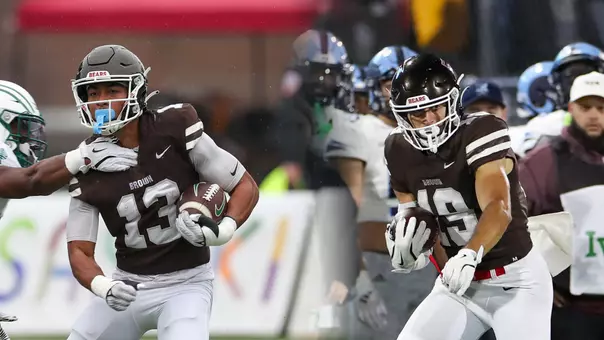
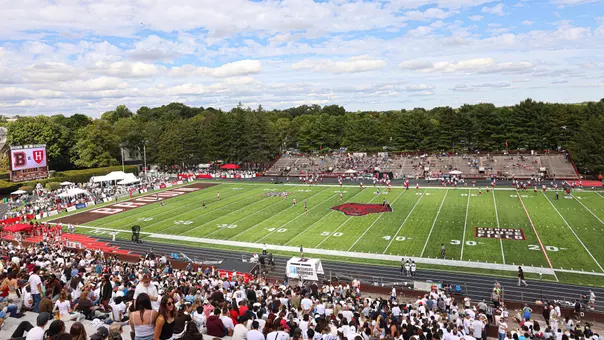
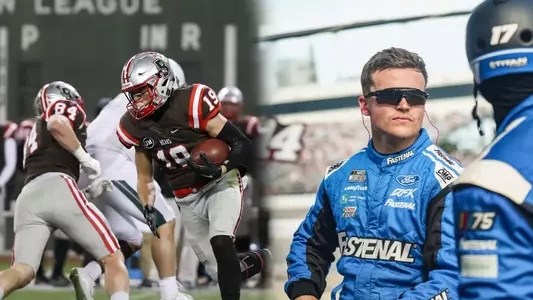
On November 23, 2019, Prall played at Brown Stadium in his final game as a wide receiver with the Bears football team; on June 11, 2022, he made his professional debut with the Saskatchewan Roughriders of the Canadian Football League; and on February 19, 2023, he competed at the Daytona International Speedway as a member of a NASCAR Pit Crew.
This fall, Prall is completing his second season suiting up for RFK Racing's Chris Buescher, who on Sept. 15 earned a victory at Watkins Glen International.
"I thought my whole world was collapsing," Prall recalled. "I was like, 'oh my gosh, everything I've worked for playing football for the past 16 years is coming to an end,' and I didn't see how I would transition out of that."
"It was a quick transition, but I wouldn't have traded it for the world. It's absolutely amazing," he added.
Prall's journey from the Bears football team to his new career at NASCAR itself featured a number of challenging pit stops — whether the COVID-19 pandemic, an unsustained stint in the CFL or growing pains transitioning between sports. But for all its twists and turns, the former wide receiver has managed to run a route resulting in end zone celebrations.
"FORM DIAMONDS OR BUST PIPES"
Prall's post-grad life began in his parents' living room in Tipp City, Ohio, where he attended the Class of 2020's virtual graduation ceremony. A two-time All-Ivy Honorable Mention who led the Bears with 48 receptions and 594 yards as a senior in 2019, Prall had his sights set on a career in football, training with fellow Ohioan, fellow Brunonian and current Los Angeles Rams defensive tackle Michael Hoecht '19.
In pursuit of landing a spot in the CFL, Prall moved in with his older sister in St. Petersburg, Florida, where he could be more easily visible to the league's coaches and general managers.
"I realized, (in) sales terminology, I got a great product but no one knows about it," he explained. "That's where everyone trains, that's where everyone connects, that's where everyone networks in the football universe."
"I kind of had to go all-in or pull my pants up and find a real-person job, so to avoid that nine-to-five desk job, I moved to Florida."
Prall said he'd been in contact with the Roughriders during their partial 2021 season, but wasn't able to meet with them in-person until the following offseason. He eventually earned an invitation to the team's training camp in May 2022, where — after adjusting to the larger field dimensions and differing rules which he analogized to "cheat codes" for offenses — he performed well enough to crack the roster.
In an interview with Global News that spring, Prall remarked: "You either form diamonds or bust pipes when pressure happens, and I like to see myself as someone that is forming diamonds."
But on August 15, Prall found himself cut from Saskatchewan's roster midway through the season.
After moving back in with his parents, a friend employed by RFK Racing recommended Prall shadow the pit crew for a day, despite him having "zero knowledge" about the job. He recognized he could thrive in the role, but was hesitant to say goodbye to his time playing professional football. After weeks of deliberation, Prall relocated to Charlotte, North Carolina — this time moving in with his younger sister — where he tried out and made it onto a crew.
"I was able to close that chapter of my life and move on," he said. "I started in a professional sport in front of thousands of fans and got paid to play football at the end of the day, which is all I could have asked for."
His move was also influenced by the opportunity to be in the same location as his girlfriend and now fiance, who happened to work for NASCAR's marketing department.
"When I got cut, we were doing long-distance still, and when this pit crew opportunity came about, I saw if I pursue this and (she moved) to the Charlotte headquarters, we could live together," he explained.
Now, the two have gone from long-distance to frequently running into each other on race tracks during the day.
"Sometimes, it's just like, 'What has happened the past few years?'" he remarked. "Neither of us knew anything about NASCAR, and now we're just fully immersed in this whole universe."
"A KICKER IN THE NASCAR UNIVERSE"
Prall's immersion into the NASCAR universe reflects a larger trend of collegiate football athletes who have switched gears to switching tires. While the two forms of competition may on the surface appear to have little in common, they overlap in their paramount reliance on teamwork, coordination, strength, speed and repeatability, as are shared prerequisites for success in many athletic activities.
"I knew they wanted athletes and that's why I was able to transition," Prall explained, "because all those qualities that I used in football translate almost one-to-one in pit crews."
Further analyzing the connection between the two sports, Prall provided a multitude of metaphors amassed through discussions between him and his fellow football-to-pit-crew converts.
In NASCAR, the pit crew essentially serves the role of a kicker: they're out of the spotlight, strategically misunderstood, and only notable when they fail.
"We are 100% a kicker in the NASCAR universe…when we have a good pit stop, no one cares how we had a good pit stop — they just want to know it was a good pit stop," Prall said. "If we screw something up and we have a really slow pit stop, no one really cares how we messed it up. They just know that we messed it up and it's our fault."
Prall admitted that this perspective has given him a newfound appreciation for his former special-teams teammates.
"It's the snap, it's the hold, it's the laces, it's the wind — it's all these factors that go into making a kick that a regular fan doesn't really care about," Prall said. "The regular fan just wants to see the kick go in."
Just as in football, there are a plethora of factors which determine the outcome of this game within a game and separate the good pit stops from the bad ones.
One such variable is whether the driver stops the car exactly on their mark. "If he goes long or if he goes short, then that means we have to go long or go short, and that's gonna add time to your pit stop," Prall explained.
"During a pit stop, you're pretty much analyzing every 10th of a second that can be gained or lost," he added. "And that can be the difference between winning or losing the race."
Within the pit crew itself, Prall observed that former football players gravitate towards different roles depending on their previous on-field position. Wide receivers like himself, with quick hands and superb coordination, transitioned well into the role of tire changer, while defensive ends or linebackers transitioned better into the role of the tire carrier or jackman — the latter referring to the member which raises the car off the ground to allow for the tires to be changed.
No matter the role, being on a pit crew requires undertaking immense amounts of physical preparation and possessing superb stamina — especially on a race day. When Prall started working as a tire changer, he would often find himself feeling sick and dizzy.
"I realized I'm burning a lot of calories, because we're in those fire suits, and on a 90-degree day you're sweating just about every ounce of water in your body," Prall said, estimating he burns about 4500 to 5000 calories each race.
While race day starts similar to a football game day might, Prall's treatment upon arrival reflects the comparatively supporting role which he plays in the main event at hand.
"(In) football, you would get to gameday, and the whole day would be about you feeling good to go play the game," Prall said. "In pit crews, you show up and you have four hours of setting up the pit box, setting up the tires, making sure that the driver is good to go for his race day, and then on top of that you're being told it's your time to perform after all that work."
Prall's adjustment to the new routine was to attempt to become "more of an endurance athlete than an interval athlete," citing the longer days which — although filled with long periods of downtime and short high-energy bursts — require that he be ready to perform at any given moment.
But Prall's transition has not been without growing pains. On March 3, he sent Buescher driving from a pit stop with a loose tire that would eventually come off the car, resulting in a two-race suspension for Prall and his crew's jackman.
"Essentially the worst thing that you can do as a tire changer is leave a lug nut loose," Prall said. "That's pretty much the cardinal sin of all pit stops, to put it in the worst terms possible."
"There's different metrics that we look at when a lug nut is fully tight on the wheel and when it's loose, and the difference between a tight lug nut and a loose lug net is almost invisible," Prall explained. "I was confident enough at the time to send the car off and let it go race, and it lasted a long time — but at the end of the day, because it was loose, it was slowly coming off."
In the wake of the suspension, Prall's teammates served as a support mechanism while he tried to bounce back.
"I didn't even want to look anyone in the eye, but one of the things that brought us closer together is my team did have my back and they supported me throughout the whole thing," he said. "Even though you wish that it would never happen again, stuff like that happens in this sport…I hope that I can support my teammates if anything drastic like that happens in the future, because they had my back at my lowest moment and I hope to have theirs."
"THE BROTHERHOOD ASPECT OF BROWN"
This sense of clubhouse camaraderie is one that transcends any individual sport, though it certainly manifests itself differently on a college campus versus a Charlotte racecourse.
"When I was at Brown, because you're living with your teammates, you go to practice with them, you go study with them in the library, and then you go get dinner with them," Prall remembered. "Today, most of the guys have families of their own. Some of them are doing it for a paycheck, some of them are doing it because they love it. There is still an awesome locker room culture here, but…it's just a different relationship."
Prall credits his Brunonian education and degree in business economics as a source of stability throughout his winding post-grad journey, noting Bears' Coordinator of Football Operations and Player Development Paul Frisone's initial recruitment pitch which presented Brown not as a "four-year plan," but a "40-year plan."
Prall also believes his status as an Ivy League graduate impacted his hiring process at RFK Racing, observing that since his arrival they've begun specifically targeting former Ivy football players to pit crews.
"They're wanting guys to think on their feet," Prall said. "Everything happens in a split second in both sports — football and being in a pit crew — so being able to process those things and understand what's going on and react to that, although it's not like a test or analytics on an excel sheet, your brain is able to process that faster and that's what they really like."
But it's what Prall called "the brotherhood aspect of Brown," whether social, academic or athletic, which seems to have influenced his outlook the most since his time with the Bears.
"Balancing really, really important things on your day-to-day schedule is definitely the best real-world translation that I took away from my time at Brown, and especially the friendships I was able to grow there," he said.
When making the tough decision of whether or not to pursue football after his covid-crashed graduation, Prall recalled a phone call with former Brown and NFL wide receiver Bobby Sewall, who urged him to take a risk.
"He basically said, 'you got to do everything you can to pursue this dream you have of being a professional athlete, and then at the end of the day you'll always have that Brown education to come back to.'"
Four and a half years later, Prall is living out the dream as a professional athlete — albeit not within the sport he envisioned. With the support of his football and pit crew family, and the hospitality of his actual family, Prall was able to chart an unconventional course from Providence to Daytona. Now, he'll look to help lead Chris Buescher and RFK Racing to a NASCAR Cup Series Championship in 2025.
"While I was at Brown, there was a lot of indecision on what path I specifically wanted to take," Prall reflected.
"I took a couple risks — and they were not rational, calculated decisions…but when you're 22 years old, you can go and do something so stupid and mess it up and then be 23 or 24 years old and start a new journey."