Cultivating Authentic Leadership: Inside Brown’s Emerging Leaders Program
12/8/2025
by: Tim Geer, Athletic Communications
Culture and leadership are two of the most critical items that can set the foundation for any successful team. And culture, as the philosophy goes, is built by leaders.
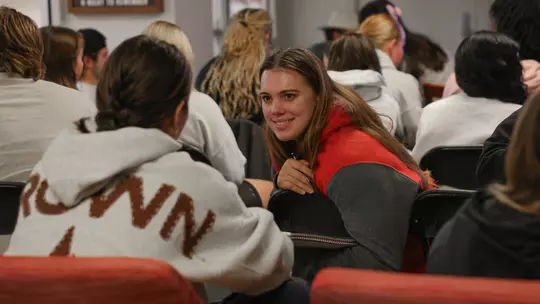
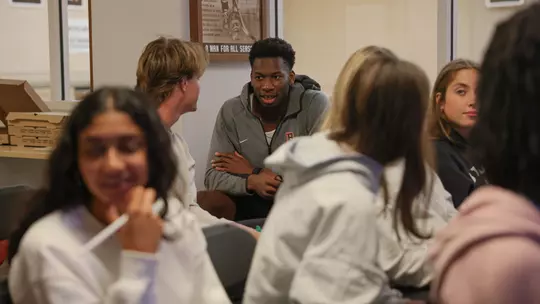
One of the keys to building that leadership within Brown’s 34 varsity sports programs is the Emerging Leaders Program, which has helped cultivate leadership among student-athletes from each team. Sessions have focused on values-based leadership, core values, building trust, communicating effectively, and high performing teams, fostering a style of leadership that is not just effective but authentic.
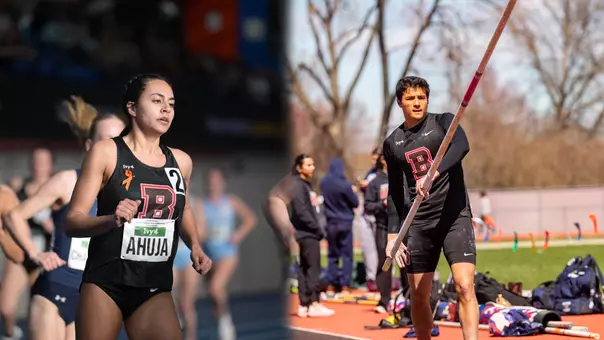
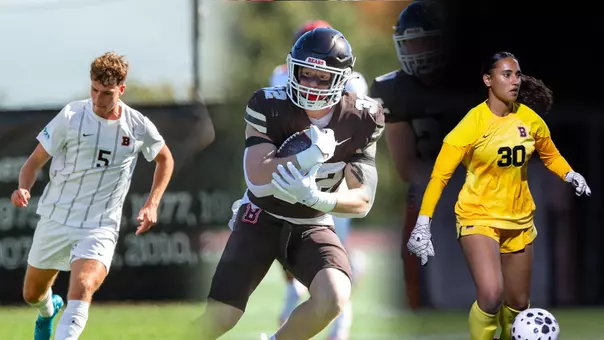
Each year, coaches are asked to nominate one or two of their student-athletes who have demonstrated great leadership through their collegiate journey. Around 50 student-athletes are selected each year and are split between the program’s fall and spring cohorts. This allows the program an opportunity to have representation from all the Athletics and Recreation Division’s teams, takes those already showing promise, and fosters a unique, cross-team learning environment that is one of the program’s greatest benefits.
Dr. Sean Hendricks, Brown’s Senior Associate Director of Athletics, Student-Athlete Development, believes that the interactions among those in the program are one of the most important pieces.
“Another significant benefit to the program is that students get a chance to bond and learn from each other,” Hendricks said. “We want to educate and carve out time and space for them to be able to reflect on their leadership.”
Recognizing the immense academic and athletic demands on student-athletes, the program is deliberately scheduled so all six weekly sessions take place in the middle of the semester, after classes begin and the student-athletes get settled into their classes, and end before the chaos of final exams.
The core of the program involves structured reflection, prompting participants to consider, "What about my leadership is working, what isn’t, and how can I continue to enhance my abilities,” Hendricks explained. This is paired with dedicated skill-building, focusing on attributes vital for success, such as the ability to be present, engaged, and curious. Hendricks shared, “We talk often about this concept of leaders building culture, culture driving behavior, and behavior is what's going to produce results.”
The content is fluid and responsive, always centering on taking ownership, being intentional, and making strategic decisions. One critical element of the program is to maximize the impact while minimizing the burden. As a result, there are no projects or “homework”. Instead, the focus is on action items.
“I’ll often ask the group at the end of the sessions, ‘What’s one action item you might take or consider as a result of today’s session?’” Hendricks said. “I think these kinds of questions are really important because you could sit there passively, but if you're not doing that deep dive and that reflection between sessions, you're not going to really get as much out of it as you possibly could.”
This focus on immediate application and sustained reflection is what turns information into transformation.
Leveraging Campus and Industry Expertise
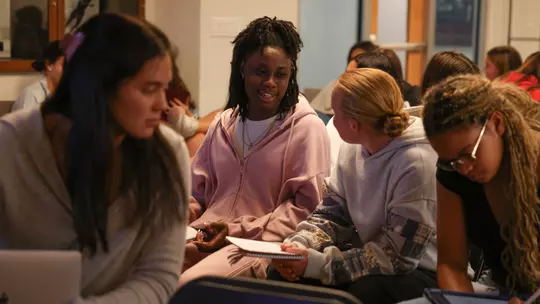
While Hendricks leads many of the sessions, to help implore reflection and harnessing skills for those in the program, many campus partners, industry experts, and coaches from across the Division have participated by sharing their unique perspectives on leadership.
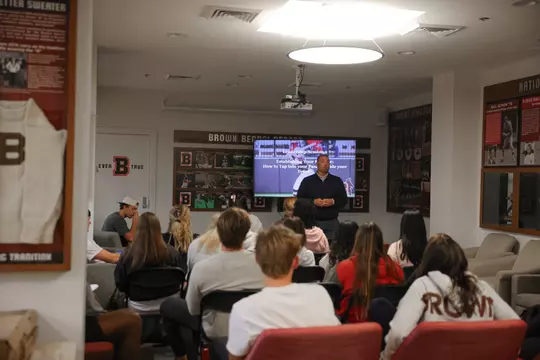
For example, as part of the Spring 2025 cohort, the program leveraged the expertise of Ted Powers, a member of the U.S. Marine Corp. who was a visiting scholar with The Watson School of International and Public Affairs. He conducted an impactful session focused on decision-making and the conscious choice of leadership, guiding student-athletes on how the power of their leadership by example can build trust and influence. Another presentation came from Jamey Mroz of Mroz Leadership Consulting, who guided them through a strategic leadership session centered on taking ownership of actions and being intentional about success. He also spoke about how relationships, focus, mindset, and energy, and how student-athletes can transform their ability to lead and generate buy-in.
Brown Head Volleyball Coach Taylor Virtue spoke about high-performing teams and how her leadership experiences throughout her career directly relate to the realities of collegiate athletics.
This fall, for the first time, the program leveraged two student-athletes to lead one of the sessions. In a powerful demonstration of the program’s mission, Frank Monahan-Morang and Joseph Oduro, who are on the Track and Field team and also serve as Problem-Solving Fellows, approached Hendricks this past summer about possibly leading a session, demonstrating that leadership learning is a cycle that can be paid forward. As Hendricks noted, “We’re trying to essentially tap into campus-wide resources and resources from the industry to make the most of the sessions.”
Measuring the Student-Athletes' Growth and the Program’s Impact
With no final exam or project involved, the students are asked to engage in a form of self-measurement that is often more valuable than a letter grade: honest self-assessment.
At the program’s conclusion, participants complete a comprehensive survey. This assessment asks them to compare their self-rated leadership skills and knowledge before the program with their level after completing the six sessions, with a heavy focus on how they applied the skills they learned.
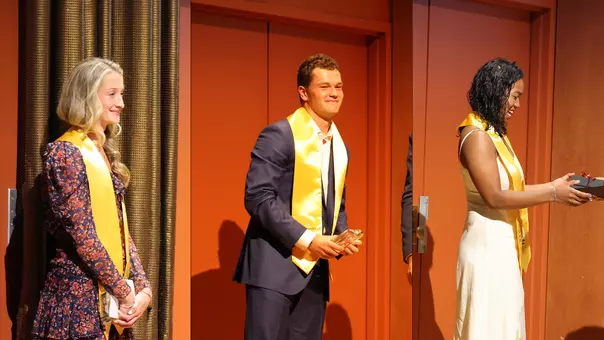
According to the final assessment from Spring 2025, 100% of participants thought the sessions were valuable, well-organized, and easy to follow, and would recommend them to other student-athletes.
“I was just selected to be a team captain a couple of weeks ago, and I have already needed to have some difficult conversations,” Kate Siedim ’27 said following the Spring 2025 cohort. “I have definitely used some of the skills I have learned from these sessions in these conversations.”
“I learned so much about how to handle conflict and disagreements without losing respect for teammates, as well as the traits of good leaders and successful teams as a whole,” Matt Purcell ’27 from men’s swimming and diving said. “The sessions truly were extremely valuable, and I look forward to implementing what I learned from here on out!”
“It was an incredibly insightful program that helped me understand what areas as a leader I still need to improve,” track/cross country runner Nina Kruzewska ‘27 said, who participated in the Fall 2025 cohort. “It challenged me to think about leadership in ways I had never thought about. I liked the interactions and meeting other student athletes, and learning leadership from a different perspective. Each sport is so unique, and each team has its own way of going about things.”
“I liked the parts when we discussed certain topics with peers; it felt very genuine and helped me connect with other athletes in the room,” baseball’s Christian Butera ’28 said, who also participated in the Fall 2025. “I am applying a lot of the sessions to my own self-reflection and how I can make myself better to make the team better. I think going through this session helped me be more cognizant of my actions and how they are reflecting on the team.”
Women’s basketball’s Ada Anamekwe ’26 echoed similar sentiments.
“I’m learning to celebrate both myself and my teammates for who we are and what we bring to the table—embracing the differences that make us unique while creating a space where everyone can come together and contribute to something bigger than ourselves,” Anamekwe said.
The investment is clear: by building better leaders, the university is building better teams, better competitors, and better individuals prepared to thrive long after their athletic careers have ended. It is a powerful, ongoing commitment to developing the whole student-athlete, one week and one cohort at a time.