
Leaps of Faith: The Bretram Rogers Story
6/13/2022
How this future surgeon carved his name into the Brown record books
by: Kim Goss
“In Brown University We Trust!” is not an official school motto, but for Bretram Rogers, it could be. That trust resulted in Rogers breaking two school records, one set in 2007 and the other in 1959 – yes, 63 years ago! Here is how he did it.
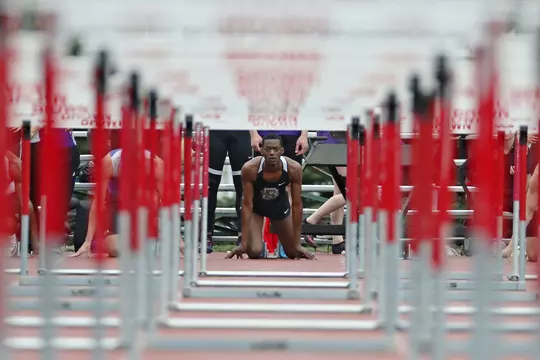
Rogers was a promising sprinter from Grand Prairie, Texas. Many prestigious colleges were interested in the young man’s athletic talents, but his career goal was to become a doctor. More specifically, a surgeon with a deep understanding of how to use technology to benefit patients. To follow that career path, Rogers needed more flexibility in his curriculum, flexibility that Brown offered by allowing him to have input in determining his electives. All good, but there was one “hurdle” in his way.
During his senior year, Rogers suffered a horrific hamstring injury that ripped muscle from bone and severed nerves. Rather than undergoing surgery, which his doctors told him had a low success rate, he decided on physical therapy. A lot of physical therapy.
Despite seven months of tedious rehab, Rogers had to accept the hard truth that some of the damage was permanent and could compromise his running mechanics. These challenges changed his recruiting status from a “There’s no need to fear...Bretram Rogers is here!” to “a project.” Brown University embraces projects. Oh, and there was another reason Brown had an interest in Rogers. Rogers displayed a powerful passion to become a doctor, a passion that began before he was born. Seriously.
A Mother’s Love
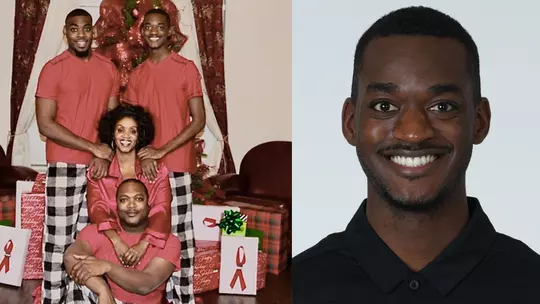
To say that Jessica Curley had a difficult pregnancy with Bretram would be an understatement. She had developed placenta previa, a rare condition that could be life-threatening to her and her baby. Despite being put on complete bed rest and having her belly constantly poked with needles to ensure her baby would receive enough fluids and nutrients, the prognosis for Bertram’s survival was bleak.
“The doctors were not seeing much progress, and it did not seem like I would live a sustainable life. The doctors urged my mother to give up, but she had faith and did not give in. Twenty-two years later, I am here to thank my mom for her determination and I am applying to medical school to treat women like her.”
Under the guidance of head sprint and hurdle coach J.J. Reise, Rogers opened the 2018 season with a respectable 8.44 seconds in the 60m hurdles. He lowered that time to 8.29, 8.25, 8.24, 8.17, and finally, 8.12. He also made improvements in the 200m, dropping from 22.69 to 22.44.
Rogers’ premier outdoor event is the 110m hurdles. He opened with 14.46, which ended up being his best official time for the season, along with a wind-aided 14.41. He also competed in the 400m hurdles once (an event he now says is his favorite), finishing with 55.49.
As he was still in the tryout stage, Rogers tried the 100m sprint event and ran an official 11.27 and a wind-aided 11.19. Fast, but not fast enough to shine in the Ivy League. Except for contributing a few team points in the relays, Rogers needed to focus on the hurdles.
The following year brought with it a new coach, Gabriel Mvumvure. During the indoor season, Rogers hit two personal records in the 60m with 8.06 and 7.95. During the outdoor season, Rogers broke his PR in the 110m three times with a best of 14.09 and a wind-aided 14.05, earning Second Team All-Ivy honors. Despite the continued success, everything with Team Rogers wasn’t all “Winner winner, chicken dinner!”

Bent, But Not Broken!
Although his hamstring was fine for normal activities, the stress of hurdling on Rogers’ body could be described as “Two steps forward, one step back.” Rogers had to listen to his body to prevent reinjuring his hamstring, and Coach Mvumvure had to continually adjust the volume (total work) and intensity (workout difficulty) of his training to avoid pushing him too hard. Prolonged warm-ups, extensive post-workout stretching, and special corrective exercises in the weightroom were also essential.
What made hurdling especially challenging for Rogers was that his landing leg, which takes the most stress, was the one he injured in high school. That stress caused microtraumas that affected his training and put him at risk for more serious injuries. To stay healthy, Rogers didn’t need to train “with pain,” but to train “with brain.”
To prevent little tweaks from becoming competition scratches, Rogers took up residency in the athletic training room. Ice baths, cupping, dry needling, assistive stretching, scrapping the skin with dull knives with a technique called Graston – track and field athletic trainer Beth Conroy threw everything at Rogers in her bag of tricks. And it worked.
The 2020 indoor season started great for Rogers in the 60m as he tied his PR with 8.06...but hold on, that time was in the qualifying heat. In the finals, Rogers broke the tape at 7.91, shattering the school record of 8.01 set by Angelo J. Sinisi in 1959 and tied by Jamil McClintock in 2006. Rogers says this is the accomplishment he was most proud of (and that he didn’t know he had broken it until a teammate told him so after the race!). Then Thanos snapped his fingers and COVID began, potentially putting an early end to Rogers’ athletic career.
Here’s the carnage COVID brought: The 2020 outdoor season was canceled along with the 2021 indoor season. Zoom sessions and home workouts were not what Rogers had signed up for, especially since he was pursuing such a challenging career field. There was one more thing – Rogers missed his teammates.
“I absolutely love my teammates; they are my brothers and sisters,” says Rogers. “We are so close and push each other to be better every second of every day, on and off the track.” These feelings were mutual, and the special relationship Rogers enjoyed with his teammates led to Coach Mvuvmure’s decision to make Rogers a team caption.
In defining his leadership role, Rogers says he was responsible for “facilitating team activities and collaborating with the coaching staff to develop an inclusive and productive training environment.” A challenging job description to recite, and a challenge to fulfill. “Because of the team’s diversity, I grew to learn how to adapt, function as an intermediary, and be an assertive yet approachable and compassionate leader. As a result, my peers often came to me for advice and sought direction,” says Rogers.
In 2021, Rogers received his undergraduate degree in Cognitive Science. Although graduation usually signaled the end of Ivy League athletes, Brown allowed an exception to be made for graduates to compete for one more year because of COVID. And when the track program was resurrected in 2022, Rogers took full advantage of this rare opportunity.
Staying on Track and Giving Back
Rogers opened his post-pandemic season with 8.18s in the indoor 60m hurdles. A good start. He brought that down to a season-best of 7.98 in his last and biggest meet, the Ivy League Championships. Along the way, he recorded a PR of 22.44 in the 200m. Great stuff, but it was the outdoor season where Rogers bought his A-game.
In April at the 2022 Sun Angel Classic Invitational, Rogers ran 13.87. This time shattered his previous best of 14.09 and broke the school record set in 2007 by Jamil McClintock. He also improved his PR in the 400m hurdles by 1.53 seconds. “Because of great coaching and a commitment to practice, I performed well on some of the largest track and field stages. This experience helped me learn to remain calm and stay focused under heavy pressure and in times of stress,” says future doctor Rogers.
Rogers was one of the six Brown athletes to qualify for the Regionals, the last qualifying meet for the Nationals. It was a fitting conclusion to Rogers’s athletic career. “Rogers has scored points for the team in every Ivy League championship, whether he was healthy or hurt. He had a different kind of drive,” said Mvumvure.

This year Rogers received his master’s degree in Biotechnology, putting him one step closer to becoming a surgeon. “Healthcare is the root of all my interests,” says Rogers. “From my collegiate studies to athletics, without my health, I wouldn’t be who I am today. Working and going to college to understand biotechnology has shown me ways of experiencing healthcare through a more holistic lens. I see how and why devices and therapeutics need to be catered to accommodate all patients, no matter their differences.”
Beyond the classroom and the track, Rogers spends his free time baking and seeking out new and exotic sources of street tacos. Oh, and one of his hidden talents is that he is a car savant. He can name every make and model on the road by sight...well, except for Buicks. He has trouble with Buicks.
On a more serious note, Rogers says that the Black maternal mortality rate in the US is five times higher than the white maternal mortality rate. “America is failing its Black mothers, even those like my mother who prevailed despite systemic discrimination. Without my mother's determination, love, and tenacity, I would not be here. I want to work on the front end to eradicate the Black maternal mortality rate pandemic so that more kids that look like me can apply to medical school and fight to end racial health disparities.”
Reflecting on these last five years, Rogers said he was proud to represent Brown while doing the sport he loved. “As a student-athlete, I developed exceptional time management and flexibility skills in balancing life, track, and school. I finished my collegiate track experience with two school records and two NCAA appearances, something I will cherish for the rest of my life.” Well said, but let’s give Coach Mvumvure the final word.
“Bretram is the caliber of athlete every coach wishes to coach,” says Mvumvure. “He was dedicated to his sport and never cheated himself in any way, shape, or form. Most importantly, he became a great leader and advocate for our program at Brown. I hope and believe that the impact Bretram Rogers left among his peers will live on.”